



Construction has always been a business of coordination.
A drawing changes at the office. Procurement needs to know. The site engineer needs the latest version. Finance needs to understand the cost implication. The project manager needs to know whether the change affects the schedule. And management eventually wants to know what all of this means for project profitability.
The problem is that many construction companies still manage these conversations across a mixture of Excel sheets, WhatsApp groups, emails, paper documents and software that rarely talks to each other.
That is beginning to change.
In 2026, construction technology is moving beyond simply digitising individual activities. The bigger shift is toward connected digital workflows, where information can move from one department to another without repeatedly being entered, downloaded, forwarded or reconciled.
Autodesk’s 2026 construction outlook similarly points toward model-based, data-driven project delivery, connected environments, automation and AI becoming increasingly embedded into day-to-day construction workflows.
For construction companies, therefore, the question is no longer:
“Which software should we buy?”
A better question is:
“What should our construction technology stack look like?”
What Is a Construction Technology Stack?
A construction technology stack is the collection of digital tools a construction company uses across marketing, sales, estimating, design, project execution, procurement, finance and management reporting.
It can include everything from the company website and CRM to BIM, project management platforms, ERP systems, mobile applications and business intelligence software.
The important word here is not technology. It is stack.
A company may own ten sophisticated applications and still operate inefficiently if every platform creates another isolated pool of information.
The goal should be to create a digital path through the business.
Ideally, information should move something like this:
Google Search → Website → Lead → CRM → Estimation → Project → Procurement → Site → Finance → Management Analytics
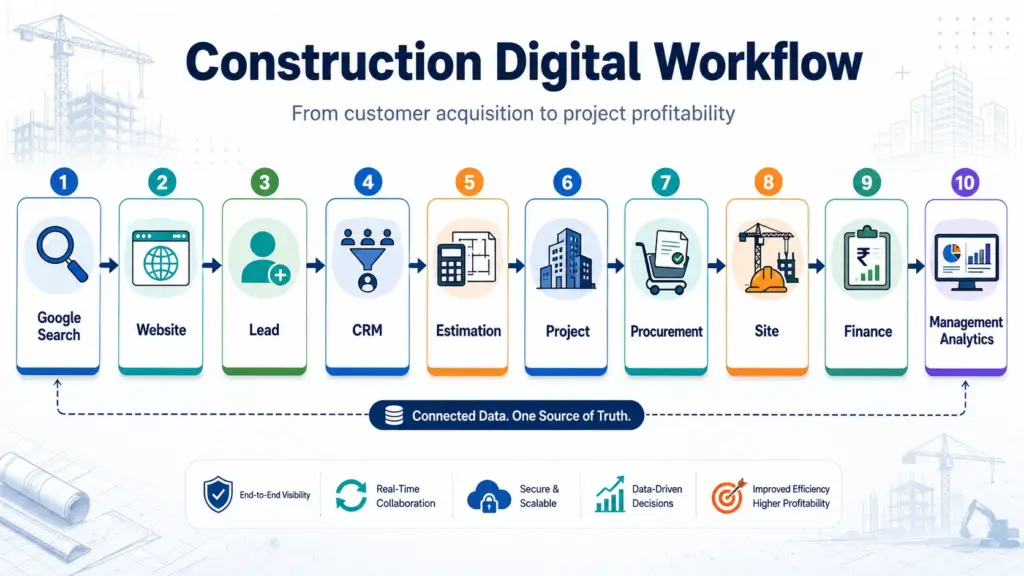
That is where technology starts becoming infrastructure rather than just another subscription.
Here are seven digital layers construction companies should consider when building that infrastructure in 2026.
1. Website, SEO and Digital Analytics: The Customer Acquisition Layer
The construction technology conversation usually starts after a project has been awarded.
But digital transformation actually begins much earlier.
Before a developer, contractor, supplier or consultant becomes part of a project, there is increasingly a digital discovery process.
A potential customer may search Google for a contractor, visit the company’s website, view completed projects, check its Google Business Profile, compare capabilities and submit an enquiry.
That makes the website one of the first components of a modern construction company’s technology stack.
A good construction website shouldn’t behave like an online company brochure from 2015. It should help prospects understand:
- what type of projects the company handles;
- which industries and locations it serves;
- what capabilities differentiate it;
- which projects it has completed;
- and how someone can start a conversation.
SEO then helps those pages become discoverable when customers search for relevant services.
Digital analytics adds another layer by answering questions such as:
Where did the enquiry come from?
Which service page generated it?
Was the visitor coming from Google, an advertisement, LinkedIn or another website?
Did they return before submitting the form?
This matters because a construction company cannot properly improve customer acquisition if it cannot connect marketing activity with actual opportunities.
The website therefore becomes the entry point into the broader construction technology stack, rather than an isolated marketing asset.
2. CRM Software: Connecting Enquiries With Business Opportunities
Generating enquiries is only useful if the company can manage what happens afterwards.
This is where customer relationship management, or CRM, becomes important.
Imagine a construction company receiving leads from its website, Google Ads, referrals, exhibitions, WhatsApp and direct phone calls.
Without a central system, those opportunities can quickly become scattered among employees’ inboxes, spreadsheets and personal follow-up lists.
A CRM creates a structured sales process.
An enquiry can be assigned to someone, categorised, followed up, moved through different stages and eventually converted into an opportunity or project.
For construction companies, the CRM should ideally answer questions such as:
How many enquiries did we receive?
Which projects are worth pursuing?
Who is following up?
What is the expected contract value?
Why are opportunities being won or lost?
More importantly, the CRM should not become another dead end.
When an opportunity becomes a live construction project, relevant information should be capable of flowing into estimating, project management or operational systems instead of being recreated from scratch.
That connection between marketing, sales and project delivery is often missing from traditional construction digital strategies.
3. BIM and Digital Design Tools: Creating a Better Project Information Base
Building Information Modelling has changed how many construction teams think about drawings.
Instead of treating design purely as a collection of separate documents, BIM allows information about building components and systems to exist within a coordinated digital model.
That creates opportunities far beyond visualisation.
Depending on the project and implementation, BIM can support coordination, quantities, constructability reviews, clash detection, planning and collaboration between design and construction teams.
In 2026, the larger direction is toward connecting these models with wider project information rather than leaving BIM isolated inside the design department. Autodesk, for example, has been moving toward an end-to-end cloud environment connecting planning, design, construction and operations.
For contractors, developers and infrastructure companies, the real value appears when design information can influence downstream decisions.
A quantity change shouldn’t simply exist as a revised drawing.
The business may also need to understand:
Does it affect the BOQ?
Does the material requirement change?
Will procurement need to order something different?
Does the change affect cost?
Will the schedule move?
The future construction technology stack therefore requires stronger connections between design data and commercial project information.
4. Construction Project Management and Common Data Environments
Construction creates enormous amounts of information.
Drawings.
RFIs.
Submittals.
Schedules.
Daily progress reports.
Inspection records.
Photographs.
Meeting minutes.
Contracts.
Safety documentation.
Quality records.
The challenge is rarely that the information doesn’t exist.
The challenge is finding the correct information when someone actually needs it.
A construction project management platform or Common Data Environment (CDE) can provide a central place for teams to work with project documents, drawings, issues and communication.
Autodesk describes a CDE as a centralised environment where project information can be stored and shared, including documents, models and drawings, while maintaining reviews and version control.
This sounds simple until you compare it with what frequently happens without one.
A drawing is revised.
One version is emailed.
Another appears in WhatsApp.
Someone downloads it to a laptop.
A subcontractor still has the previous PDF.
Meanwhile, the latest revision sits somewhere else entirely.
Centralised project information reduces the dependence on employees knowing exactly who has the newest document.
An Indian example comes from Shapoorji Pallonji E&C, which described challenges created by siloed information and manual reporting before moving toward a more unified digital environment for field, planning and billing data.
For construction businesses managing several sites simultaneously, this layer becomes increasingly important because project knowledge should belong to the organisation—not to one person’s inbox.
5. Construction ERP Software: Connecting Projects With Business Operations
Project management tells you what is happening on the project.
But management eventually needs to know what it means financially.
That is where construction ERP software can become another important layer of the construction technology stack.
Generic accounting software may record transactions perfectly well, but construction businesses deal with additional complexity: BOQs, project budgets, material requisitions, procurement, subcontractors, equipment, inventory across sites, running bills, retention, project-wise accounting and cost-to-complete calculations.
Construction-focused ERP systems attempt to connect those activities.
For example, instead of treating the purchase of steel as an isolated accounting transaction, a connected workflow might look like:
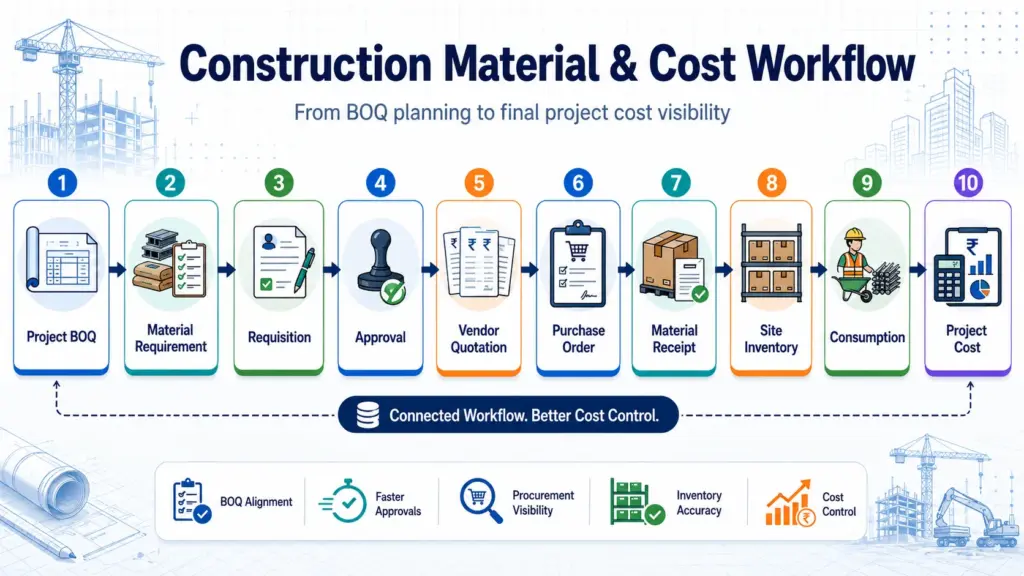
Project BOQ → Material Requirement → Requisition → Approval → Vendor Quotation → Purchase Order → Material Receipt → Site Inventory → Consumption → Project Cost
The important benefit is not simply replacing paper with screens.
It is maintaining the relationship between the physical activity taking place on-site and the financial impact visible to management.
Oracle’s current construction project-management portfolio similarly emphasises connecting schedules, project controls, cost information, contracts and field teams so changes can be understood alongside their cost impact.
This becomes particularly valuable for companies operating multiple projects.
A CFO may want to see costs across the organisation.
A project manager wants the position of one project.
Procurement wants pending requirements.
Stores need stock visibility.
Management wants profitability.
A properly integrated ERP layer helps those teams work from connected operational data rather than maintaining separate versions of reality.
6. Mobile Field Technology, Drones and Reality Capture
A digital construction system fails if all the useful data stays inside the head office.
The site is where much of the information originates.
That is why mobile-first field technology has become increasingly important.
Site engineers and supervisors can use mobile devices to record progress, raise issues, access drawings, submit daily reports, capture photographs, request materials or complete inspections without waiting to return to an office computer.
Reality-capture technologies add another dimension.
Drones, 360-degree cameras, laser scanning and other imaging technologies can create more frequent records of actual site conditions.
The purpose isn’t to use technology because it looks impressive in a presentation.
It is to reduce the distance between what management thinks is happening and what is actually happening on-site.
If a project claims to be 65% complete, increasingly sophisticated digital systems can combine field records, images, schedules and models to help validate progress.
Current industry thinking is moving in this direction. Autodesk’s 2026 construction outlook highlights growing use of drones, 3D scanning, computer vision and other technologies alongside project controls and digital models.
The stronger construction technology stacks will therefore connect field capture with project data rather than storing thousands of photographs in another disconnected folder.
7. Business Intelligence, Automation and AI: Turning Data Into Decisions
Once construction companies digitise their workflows, they encounter a new problem:
They have more data than anyone has time to read.
That is why analytics, automation and AI are becoming the final layer of the modern construction technology stack.
Business intelligence dashboards can combine information from different systems to answer management-level questions.
Which projects are falling behind schedule?
Where are costs exceeding budgets?
Which vendors regularly deliver late?
Which projects have large outstanding receivables?
Which marketing channel is generating the most valuable opportunities?
Which material category has experienced the highest cost increase?
AI can take this further by helping teams search documents, summarise reports, identify unusual patterns, extract data and highlight potential risks.
But there is an important catch.
AI cannot fix bad digital foundations.
If project data is incomplete, duplicated, outdated or distributed across dozens of unconnected platforms, adding an AI assistant on top will not suddenly create reliable business intelligence.
Autodesk’s 2026 AI outlook makes a similar point: the value of AI increasingly comes from integrating it into existing workflows and connecting structured and unstructured construction data.
This is why construction companies should think about data architecture before chasing every new AI tool.
The Biggest Technology Mistake: Buying Tools Without Building the Stack
Digital transformation does not mean buying seven tools next month.
In fact, that approach can make things worse.
Every new platform creates another login, another database and another place where employees can enter information.
Research referenced by Autodesk has found that some construction leaders already feel they store data across too many platforms.
The better approach is to start with workflows.
Take one real process:
A website enquiry becomes a ₹20 crore project.
Now map the information journey.
Where was the lead generated?
Where was the opportunity tracked?
Where was the estimate created?
Where is the project scheduled?
Where are drawings stored?
Where are purchase orders approved?
Where is the project cost recorded?
Where does management see profitability?
If employees repeatedly copy information between Excel sheets and applications, you have found an integration gap.
Fixing those gaps can be more valuable than purchasing another standalone product.
What Should Construction Companies Prioritise First?
Not every contractor needs the same technology stack.
A local contractor with three active projects has different requirements from an infrastructure company managing fifty projects across several regions.
Before investing in technology, evaluate three things:
Where is information being duplicated?
If teams repeatedly enter the same project, vendor, customer or cost information into multiple systems, integration should become a priority.
Where are decisions being delayed?
Look for reports that take hours or days to prepare because information has to be collected manually.
Where is visibility missing?
If management regularly asks questions that nobody can answer without calling several employees, there is probably a data problem underneath.
Technology selection should start there.
From Search Visibility to Project Profitability
One of the most interesting changes in construction technology is that the traditional boundary between front-office and back-office systems is disappearing.
Marketing knows where customers came from.
CRM knows which opportunities converted.
Estimating knows the expected project value.
Project management knows the progress.
ERP knows the costs.
Analytics knows the outcome.
When those pieces begin to connect, a construction company can ask much more valuable questions.
Instead of simply asking:
“How many website leads did we generate?”
management can eventually ask:
“Which marketing channel generated the projects with the highest profitability?”
That is a very different level of digital maturity.
It also explains why construction companies should stop evaluating software as isolated departments.
The future is not simply SEO software, CRM software, BIM software, project-management software and ERP software.
The future is the flow of reliable information between them.
Final Thoughts
The construction company of 2026 does not need technology everywhere.
It needs the right technology in the right places, connected in the right way.
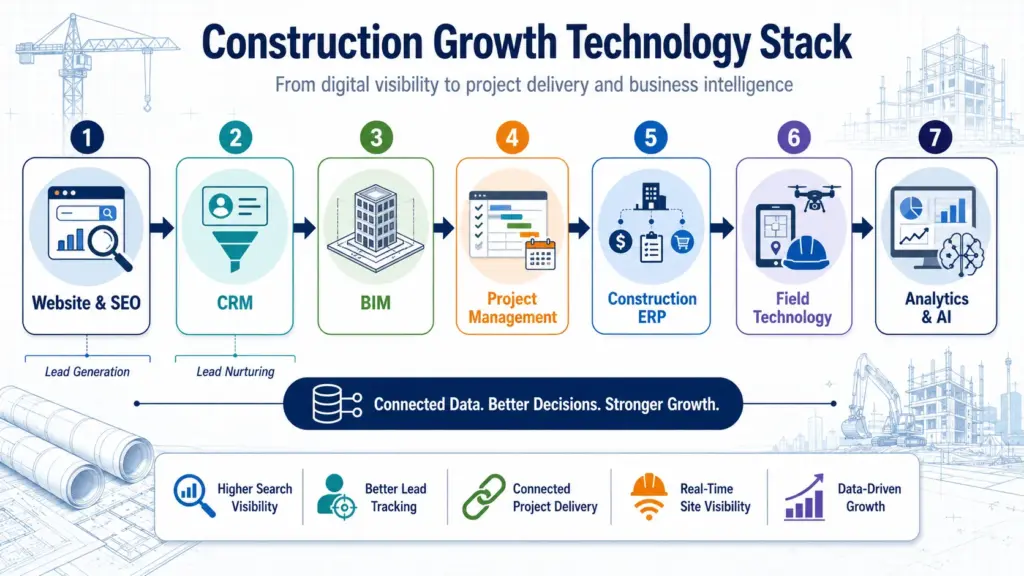
A modern construction technology stack should help a business move information smoothly from customer acquisition to project delivery and finally to financial performance.
For many companies, that stack will include:
Website and SEO → CRM → BIM → Project Management → Construction ERP → Field Technology → Analytics and AI
The individual products will continue to change.
AI capabilities will improve. Platforms will merge. New applications will appear.
But the principle is unlikely to change:
The most valuable construction technology is technology that helps the right person get the right information at the moment a decision needs to be made.
Construction businesses that design their digital systems around that principle will be far better prepared for whatever technology comes next.
Frequently Asked Questions
What is a construction technology stack?
A construction technology stack is the collection of digital systems a construction company uses to manage activities such as marketing, customer enquiries, estimating, design, project management, procurement, finance, field operations and business analytics.
What technology do construction companies use?
Construction companies may use CRM systems, BIM software, construction project management platforms, construction ERP software, estimating tools, mobile field applications, drones, document management systems, business intelligence platforms and AI tools.
Why is integration important in construction technology?
Integration reduces repeated data entry and helps information move between departments. For example, project information created during estimation can later support procurement, project management, finance and reporting instead of being recreated separately.
What is the difference between construction project management software and construction ERP software?
Construction project management software generally focuses on project execution activities such as schedules, drawings, RFIs, tasks, collaboration and site information. Construction ERP software typically connects project operations with procurement, inventory, billing, accounting and broader financial management.
Can AI improve construction project management?
AI can assist with tasks such as document search, report summarisation, data extraction, risk identification, scheduling analysis and progress monitoring. Its usefulness depends heavily on the quality and availability of the underlying project data.
Do small construction companies need a complete technology stack?
Not necessarily. Smaller companies should prioritise their biggest operational problems first. A simple connected system that employees consistently use can be more effective than several sophisticated applications operating independently.
What should construction companies digitise first?
Start with processes where information is frequently lost, duplicated or delayed. Lead management, drawings and documents, project reporting, procurement, cost tracking and management reporting are common areas worth evaluating.